Home / Appliance repair / Wine cooler repair
Wine cooler repair
in the Bay Area
A wine cooler fails quietly. A refrigerator announces itself with warm milk the next morning, but a cooler drifting from 55°F to 70°F gives no sign until a bottle is opened months later and the wine is flat. That is why we treat these as urgent even when nothing looks wrong: by the time the symptom is obvious, the collection has already paid for the repair several times over.
Symptoms
What we see most.
If any of this sounds like your unit, the diagnosis is usually straightforward and the repair is same-visit.
Temperature climbing above the setpoint
Usually a choked condenser, a failed condenser fan or a refrigerant problem. On a built-in the first suspect is always airflow, not the sealed system.
Bottles freezing at the back
A thermostat or sensor reading the wrong spot, or a stuck-open damper. Freezing pushes corks and ruins wine faster than heat does.
Dual-zone unit showing the same temperature in both zones
The damper between zones has failed, or one zone's sensor has drifted. The compressor is usually fine — this is a control fault.
Condensation or fog inside the glass door
A perished door gasket letting humid room air in, or a failed door heater on units that have one. Left alone it turns into mould in the seal channel.
Loud hum or buzzing you can feel through the cabinet
Failed compressor mounts or a fan blade catching. Vibration matters more here than on a fridge — it disturbs sediment and it will be noticed in a quiet room.
Display reads correctly but the wine is warm
A drifted sensor telling the board what it wants to hear. We verify against an independent thermometer before touching anything.
Running constantly and never cycling off
Lost refrigerant charge, a dirty condenser, or a unit installed somewhere hotter than it is rated for. Common on coolers pushed into a sealed cabinet run.
Frost building on the back wall
A defect in defrost control or a door not sealing. Frost on the evaporator insulates it and cooling gets worse from there.
A whole cellar room drifting while the unit still runs
Undersized capacity, a slow refrigerant leak, or a vapour barrier problem in the room rather than the equipment. We measure before assuming the unit is at fault.
What we service
Undercounter, full-height, thermoelectric and whole-cellar systems.
Built-in & undercounter coolers
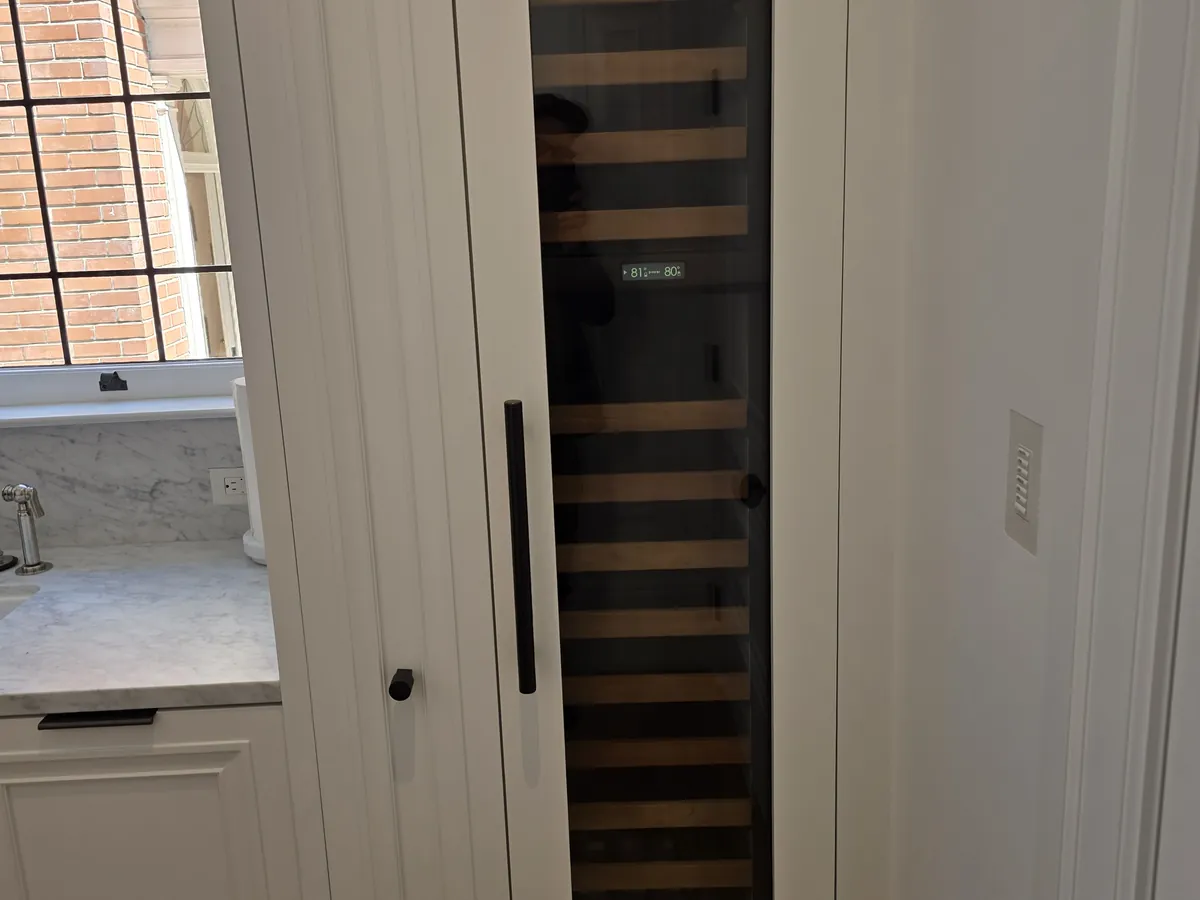
Cabinetry-integrated units that vent through a toe-kick grille at the front. They cannot be pulled out easily, so diagnosis and repair happen in place.
- Toe-kick grille and condenser cleaning
- Condenser fan replacement
- Door seal and hinge alignment
- Sealed system diagnosis
Full-height & dual-zone cabinets
Large-capacity units holding two separate temperature bands for reds and whites, often carrying a significant collection.
- Zone damper and sensor repair
- Dual thermostat calibration
- Compressor and start relay work
- Glass door gasket replacement
Thermoelectric & compact coolers
Small units with no compressor, cooling by Peltier module. They fail differently and the repair economics are different too.
- Peltier module testing
- Cooling fan replacement
- Control board diagnosis
- Honest advice when repair is not worth it
Wine cellar cooling systems
Purpose-built units conditioning a whole room rather than a cabinet — through-wall, ducted and split. This is refrigeration engineering rather than appliance work, which is why fewer companies take it on.
- Through-wall and ducted unit service
- Split system and lineset diagnosis
- Refrigerant leak detection and charge
- Humidity control and condensate drainage
Common causes
Why it breaks down.
Built-ins breathe through one small grille, and it packs with dust
The toe-kick grille is the entire air path. When it clogs, head pressure climbs, the compressor runs longer and hotter, and the unit slowly loses the ability to hold temperature.
They hold a narrow band with a small compressor
A wine cooler defends a few degrees around 55°F, not a wide range. There is little margin, so a fault that a refrigerator would shrug off shows up here as drift.
Glass doors leak heat and the gasket is the weak point
A glass door is a thermal hole by design. Everything depends on the seal, and seals harden and shrink with years of temperature cycling.
Inland Bay Area summers push undersized units past their rating
Los Gatos, Cupertino and the inland Peninsula get genuinely hot. A cooler rated for a 75°F room struggles in a kitchen that reaches 85°F.
Garage installs are the single most common mistake here
Bay Area garages swing far outside what these units are rated for. A cooler installed in one will run constantly in summer and may stop cooling entirely in winter.
Condenser fans are small, cheap and fail silently
There is no noise to warn you. The fan stops, the temperature creeps up over weeks, and nothing else looks wrong until the wine is already affected.
Care tips
Keep it running longer.
- Vacuum the toe-kick grille every few monthsThis one habit prevents more wine cooler failures than everything else combined. It takes two minutes and it is the whole ventilation system.
- Check the real temperature with an independent thermometerDisplays drift. A cheap thermometer sitting on a shelf for a day tells you what the wine is actually experiencing.
- Never install a cooler in the garageIt is the most common siting mistake in this area. These units are rated for indoor room temperatures, and a Bay Area garage is not one.
- Leave the rated clearance on freestanding unitsA freestanding cooler pushed flush into a cabinet run has nowhere to reject heat. If it was not sold as built-in, it needs air behind it.
- Test the door seal with a sheet of paperClose the door on a sheet of paper and pull. If it slides out with no resistance anywhere along the seal, the gasket is done.
- Keep it reasonably fullBottles are thermal mass. A full cooler rides out door openings and short power cuts far better than a half-empty one.
Pricing
Priced after diagnosis, not before.
Parts and labor for wine cooler repair vary too much by brand and fault to publish a flat rate honestly. A technician diagnoses the issue on site and gives you the exact price in writing — nothing starts until you approve it, and the diagnostic fee is applied to the repair.
Service area
Wine cooler repair across the Bay Area.
Same technicians, same warranty, same pricing rules, from San Francisco down to the South Bay and out to Marin. Pick your city for local response times and what we see most in your neighborhood.
Questions
Before you call.
Do you service wine cellar cooling systems, not just cabinets?
Yes — through-wall, ducted and split cellar units including WhisperKool, CellarPro and Wine Guardian. These are refrigeration systems rather than appliances: they need refrigerant handling, airflow and load calculation rather than parts swapping, and that is the same work our commercial refrigeration side does every day.
My wine cooler stopped cooling. Is it worth repairing?
Usually yes, and especially on a built-in. The common faults are a choked condenser, a dead condenser fan or a failed sensor, and all of them are contained repairs against the cost of a cabinetry-matched replacement. We tell you honestly when a unit is not worth it.
Do you work on built-in Sub-Zero, U-Line and Marvel wine storage?
Yes. Built-in and undercounter wine refrigeration is regular work for us, including units that have to be diagnosed in place because they cannot be pulled out of the cabinetry.
Why does my dual-zone cooler show the same temperature in both zones?
Almost always the damper between the zones has failed or one zone's sensor has drifted, not the compressor. It is a control-side fault and it is usually one of the cheaper repairs on these units.
There is condensation inside the glass door. Is that a problem?
It means humid room air is getting past the gasket, or the door heater has failed on units that have one. It is worth fixing promptly, because that moisture ends up as mould in the seal channel and in the labels.
What temperature should a wine cooler actually hold?
Around 55°F for long-term storage, with reds and whites split higher and lower on a dual-zone unit. What matters more than the exact number is that it stays steady — swings do more damage than a couple of degrees off target.
How much does wine cooler repair cost?
It depends on the fault. A condenser clean, a fan or a sensor is at the lower end; a compressor or sealed system repair is a larger job. We diagnose first and give you the price in writing before any work starts.
Book a technician
Get a same-day window.
- ☎(628) 285-0504Fastest way to reach a dispatcher
- ✉info@volteight.comEstimates, invoices, commercial contracts
- ⌚Mon–Fri 8am–10pm · Sat–Sun 8am–5pmEmergency calls answered after hours
- ⌖San Francisco Bay AreaMarin, San Francisco, East Bay, Peninsula, South Bay