Home / Appliance repair / Microwave repair
Microwave repair
in the Bay Area
A microwave that runs but doesn't heat is almost always one of four parts: the magnetron, the high-voltage diode, the capacitor or a door interlock switch. Three of those sit behind a capacitor that holds a lethal charge after the unit is unplugged, which is the reason this is not a DIY appliance no matter what the video says.
Symptoms
What we see most.
If any of this sounds like your unit, the diagnosis is usually straightforward and the repair is same-visit.
Runs but doesn't heat
The classic magnetron or high-voltage diode failure. The fan turns, the light is on, the plate spins — and the food stays cold.
Dead, no display, no response
Usually a blown thermal fuse or line fuse acting as a safety cutout, and something upstream caused it to blow. We find the cause, not just the fuse.
Turntable won't rotate
A failed turntable motor or a stripped coupler. Cheap part, and it's genuinely worth fixing rather than living with cold spots.
Sparking or arcing inside
Stop using it. Usually a burnt waveguide cover or damaged cavity paint, and both need addressing before the next use.
Door won't latch or unit won't start
Microwaves use three interlock switches in series as a safety chain. One failed switch stops everything, by design.
Buttons unresponsive or panel glitching
A failed membrane keypad or a control board fault. Testing tells them apart — replacing the wrong one is an expensive guess.
Loud buzzing or grinding while running
A failing magnetron under load, or a worn cooling fan bearing. The sound pattern tells us which.
Over-range unit not venting
The combination units double as a range hood, and the fan, damper or filter side can fail independently of the microwave itself.
What we service
Built-in, over-range and drawer — all serviced.
Built-in & wall-oven combination
Trim-kitted units set into cabinetry, often stacked with a wall oven. They can't be pulled out to work on, and the trim kit has to come off correctly to avoid damaging the cabinetry.
- Magnetron and high-voltage component replacement
- Door interlock and latch assembly repair
- Control board and keypad diagnosis
- Trim kit removal and refit
Over-the-range microwaves
Doing two jobs at once — microwave and range hood — which means twice the failure surface and a mount that carries real weight above a cooking surface.
- Vent fan and damper repair
- Charcoal and grease filter service
- Mounting bracket and support checks
- Magnetron and diode replacement
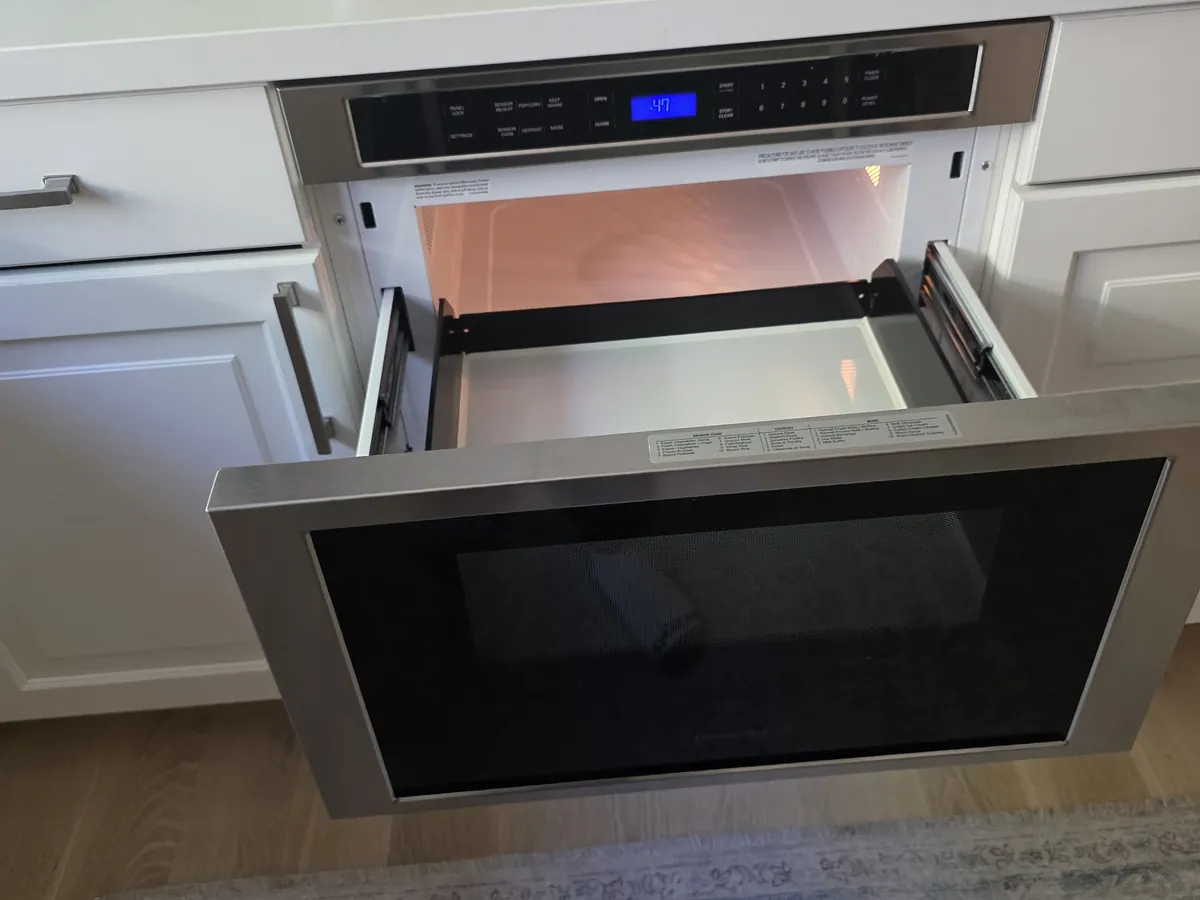
Microwave drawers & countertop units
Drawer models built into islands and cabinetry, plus freestanding countertop units.
- Drawer motor and track repair
- Door and latch mechanism service
- Turntable motor and coupler replacement
- Thermal fuse and safety circuit diagnosis
Common causes
Why it breaks down.
Magnetrons have a finite operating life
The tube that generates the microwaves wears out with cumulative running hours. Somewhere past year seven or eight on a heavily used unit, this becomes wear rather than defect.
Running the unit empty destroys the magnetron
With no food to absorb the energy it reflects straight back into the tube. A few seconds is survivable; a few minutes is not.
Door interlock switches see every single use
Three switches operate every time the door opens and closes. They're small mechanical parts doing thousands of cycles, and they're a common failure point.
Grease builds up inside over-range units
Mounted directly above a cooktop, these pull cooking grease into the vent path and eventually into the electronics. It's the reason over-range units fail more often than built-ins.
The waveguide cover burns through
That small mica panel inside the cavity shields the waveguide. Food splatter carbonises on it, it starts arcing, and left alone it damages the cavity behind it.
Metal or foil in the cavity causes arcing damage
One accident with a foil-wrapped item can pit the cavity paint, and once the coating is broken the exposed metal keeps arcing on every subsequent use.
Care tips
Keep it running longer.
- Never run it emptyThere has to be something inside to absorb the energy. An empty cavity sends it back into the magnetron and shortens its life measurably.
- Cover food while heatingSplatter that carbonises on the waveguide cover is the leading cause of arcing, and covering the plate prevents almost all of it.
- Wipe the cavity and the waveguide cover regularlyA damp cloth on the interior and that small mica panel takes a minute and prevents the most common avoidable failure.
- Clean the grease filters on over-range unitsMonthly in a household that cooks. A saturated filter pushes grease into the fan housing and the electronics behind it.
- Close the door gentlyThe interlock switches are mechanical and they're the part that most often ends a microwave's life. Slamming the door wears them out faster.
- Stop using it immediately if it arcs or smells burntArcing damages the cavity progressively. One more use to finish dinner is how a repairable fault becomes a replacement.
Pricing
Priced after diagnosis, not before.
Parts and labor for microwave repair vary too much by brand and fault to publish a flat rate honestly. A technician diagnoses the issue on site and gives you the exact price in writing — nothing starts until you approve it, and the diagnostic fee is applied to the repair.
Brands we service
Sharp, Panasonic, GE, Whirlpool, LG, Samsung, Bosch, Thermador, Miele, Wolf, KitchenAid, Frigidaire
Service area
Microwave repair across the Bay Area.
Same technicians, same warranty, same pricing rules, from San Francisco down to the South Bay and out to Marin. Pick your city for local response times and what we see most in your neighborhood.
Questions
Before you call.
My microwave runs but doesn't heat. Is it worth repairing?
It depends on the unit. On a built-in or drawer model set into cabinetry, almost always yes — the appliance is expensive and the trim kit is matched to your kitchen. On a low-cost countertop unit, the magnetron replacement usually costs more than the microwave is worth, and we'll tell you that rather than sell you the repair.
Can I replace a magnetron myself?
We'd strongly advise against it. The high-voltage capacitor stores a charge capable of killing you well after the unit is unplugged, and it has to be discharged correctly before anything else is touched. This is the one appliance where the safety margin is genuinely thin.
Do you service built-in and drawer microwaves?
Yes — built-in trim-kitted units, wall-oven combinations and drawer models are a regular part of our work. These are the ones most worth repairing, since replacement means matching the cabinetry cutout.
My over-range microwave still heats but the fan doesn't work. Can that be fixed separately?
Yes. The ventilation side — fan motor, damper, filters — is a separate system from the microwave itself and can be repaired on its own.
It sparked inside. What do I do?
Stop using it and call. It's usually a burnt waveguide cover, which is inexpensive to replace, but continuing to run it damages the cavity behind it and turns a small repair into a scrapped appliance.
How much does microwave repair cost?
It depends heavily on the part and the type of unit. Door switches, turntable motors and fuses are minor repairs; a magnetron on a built-in is a larger job. We diagnose first and quote in writing before starting.
Book a technician
Get a same-day window.
- ☎(628) 285-0504Fastest way to reach a dispatcher
- ✉info@volteight.comEstimates, invoices, commercial contracts
- ⌚Mon–Fri 8am–10pm · Sat–Sun 8am–5pmEmergency calls answered after hours
- ⌖San Francisco Bay AreaMarin, San Francisco, East Bay, Peninsula, South Bay